
If you’ve spent more than five minutes in a kitchen with a toddler, a Golden Retriever, or a grandchild who just discovered that spaghetti doubles as a ceiling decoration congratulations. You’ve officially lived through a localized natural disaster.
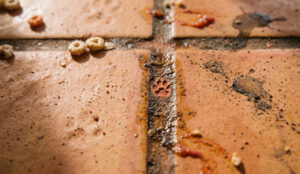
Here in Southern Utah, we have a very specific brand of chaos. It’s a cocktail of red dirt tracked in from Snow Canyon, sticky apple juice boxes, and that mysterious “grout juice” that happens when a new puppy thinks the kitchen rug is a suggestion rather than a rule. Whether you’re a tired parent in St. George trying to survive the week or a grandma in Cedar City wondering how three kids managed to turn your floor into a sticky mosaic in under an hour, I have some news: It’s not your fault.
Tile is supposed to be the “easy” flooring, right? That’s the lie we were all sold. But your grout? That’s basically a hard-surfaced sponge that is currently recording a historical record of every meal you’ve cooked since 2022.
The Anatomy of a Kitchen Disaster
The kitchen is the heart of the home, which also makes it the primary target for every stain-maker in the zip code. To fix the problem, we have to look at the specific culprits turning your grout lines into a colorful (and smelly) timeline:
- The “Red Dirt” Factor: In St. George, our dirt isn’t just dirt; it’s a high-performance pigment. Iron oxide gives our soil that beautiful red hue, but it also means that once it’s tracked in from a hike or the backyard, it doesn’t just sit on top of the tile. It hitches a ride on moisture and finds its way into the microscopic pores of your grout. Once there, it “sets up shop,” effectively dyeing your once-white grout a permanent shade of “Southern Utah Sunset.”
- The Puppy Problem: Even the cutest puppy has “oops” moments. Because grout is incredibly porous, it acts like a thirsty stone. When a spill or accident happens, the liquid is pulled deep into the substrate. This is exactly why your grout smells weird even after you’ve mopped three times. You’re cleaning the surface, but the organic material is throwing a party in the basement of your floor.
- The Sticky Fingers: Toddlers don’t just eat; they distribute. High-chair debris, spilled apple juice, and the inevitable “mashed berry” incident create a microscopic film on your tile. This film is a magnet. It captures pet dander, dust, and red dirt, turning your kitchen floor into a tactical obstacle course of stickiness that standard household cleaners just can’t dissolve.
- The Grease Trap: If you cook at home, you’re dealing with “aerosolized grease.” Every time you sauté or fry, tiny particles of oil float through the air and land on the floor. This grease bonds with the dirt in your grout, creating a dark, sticky paste that is nearly impossible to remove with a traditional mop.
Why Your Mop is Actually a Double Agent
I’m going to tell you something that might hurt: your mop is probably making things worse. It’s less of a cleaning tool and more of a “grime redistribution system.”
Think about the physics of it. You dunk your mop into a bucket of water and soap, swipe it across the floor, and dunk it back in. By the third pass, you aren’t cleaning with fresh water; you’re spreading a thin soup of bacteria, old milk, and dissolved red dirt across your kitchen.
As you drag that damp mop over the floor, the water naturally seeks out the lowest points which happen to be your grout lines. The grout acts like a squeegee, stripping the dirty water off the tile and pulling it deep into its porous valleys. The water eventually evaporates, but the “souvenir” it brought along the dirt, grease, and microscopic nastiness stays behind. This is why your floor looks clean but smells gross. You aren’t removing the mess; you’re just relocating it into the permanent storage units of your floor.
Pro Tips for Kitchen Tile Maintenance (Between the Chaos)
If you aren’t quite ready to call in the cavalry yet, here are a few ways to fight back against the daily kitchen grind:
- Blot, Don’t Scrub: When the spaghetti hits the floor, your instinct is to scrub like you’re trying to win an Olympic medal. Don’t. Grab a microfiber cloth and blot from the outside in. Scrubbing acts like a piston, pushing tomato sauce and oils deeper into the “pores” of the grout. Once it’s in there, it’s a resident, not a visitor.
- Ditch the Heavy Chemicals: Those “Extreme Grout Cleaners” you find at the big-box stores in St. George are often highly alkaline or loaded with bleach. They might look like they work initially, but they leave a soapy residue behind. That residue is basically a “Welcome” mat for more dirt. Use a pH-neutral cleaner or better yet, a specialized “no-rinse” tile cleaner to keep your floors from becoming a sticky magnet for red dirt.
- Vacuum First (The Golden Rule): This is the biggest mistake we see in Southern Utah. If you introduce water to red dirt before removing the loose particles, you aren’t cleaning you’re making mud. And that mud loves to settle right into your white grout lines. Always vacuum or sweep thoroughly before you even think about grabbing the mop.
- The “Water Test”: Pour a few drops of water onto your grout lines in a high-traffic area. Does it bead up like a freshly waxed car? Great, your sealer is holding. Does it soak in and turn the grout dark immediately? Your sealer has failed. Unsealed grout is an open invitation for permanent staining and bacterial growth.
- Steam is Your Friend: If you have a small home steam mop, use it sparingly. It’s better than a chemical-soaked mop, but remember: without extraction (sucking the water back up), you’re still just loosening the dirt and letting it settle back into the grout.

TBird to the Rescue: Your Floor’s Superheroes
At TBird Carpet Care, we don’t just show up; we stage a tactical intervention. We’ve spent over 70 years perfecting the art of the deep clean, and while we don’t technically wear capes (they get caught in the machinery), we definitely bring the hero energy. We don’t just “mop” your floors; we deploy truck-mounted, high-pressure hot water extraction. Think of it as a localized pressure-washing superpower with a built-in vacuum that sucks the “oops” right out of your house and into our truck.
We pride ourselves on white-glove service that would make a butler jealous. Whether you’re in the heart of St. George or up the hill in Cedar City, we bring the high-tech gear and the “save the day” attitude that makes your floors feel the love they deserve.
Kitchen Tile Cleaning FAQ (The Quick Answers)
How do I get the “dog smell” out of my kitchen tile? Standard mopping only cleans the surface of the tile, but pet odors live deep inside the grout’s pores. To eliminate the smell, you need a professional extraction that utilizes an enzymatic treatment. These enzymes specifically target and break down the proteins in pet waste and dander. Without this, the bacteria will continue to reactivate every time the floor gets even slightly damp.
What is the best way to clean kitchen tile grout? For daily maintenance, use a pH-neutral cleaner and a microfiber mop to avoid leaving a residue. However, for a true “reset,” professional steam cleaning is required. We use specialized tools that hit the floor with 200+ degree water while simultaneously vacuuming up the waste. This heat sanitizes the floor and emulsifies grease and oils that a standard mop simply can’t touch.
Why is my tile floor still sticky after mopping? Sticky floors are almost always caused by “surfactant buildup.” This happens when you use too much floor cleaner or a product that isn’t pH-neutral. The soap dries on the surface, creating a microscopic “glue” that attracts dust, pet hair, and dirt the moment you walk on it. To fix this, you need to strip the old soap away with a professional deep clean and switch to a no-rinse, neutral cleaner for daily use.
How often should I get my kitchen tile professionally cleaned? In high-traffic Southern Utah homes especially those with kids, pets, or red-dirt enthusiasts we recommend a professional deep clean every 12 to 18 months. This frequency ensures that your grout sealer remains intact and that organic material doesn’t have time to permanently stain the grout lines or breed bacteria in your cooking space.
Ready to reclaim your kitchen?
If your kitchen tile has seen better days or if the “grandkid + puppy” combo finally won the war let us help. We’re the experts in St. George Tile and Grout Cleaning, and we’re ready to make your floors look like the day you moved in.
Check out our full Tile and Grout services or contact us today for a free estimate. We’ll handle the grime; you just keep making the memories (and maybe keep the spaghetti off the ceiling).